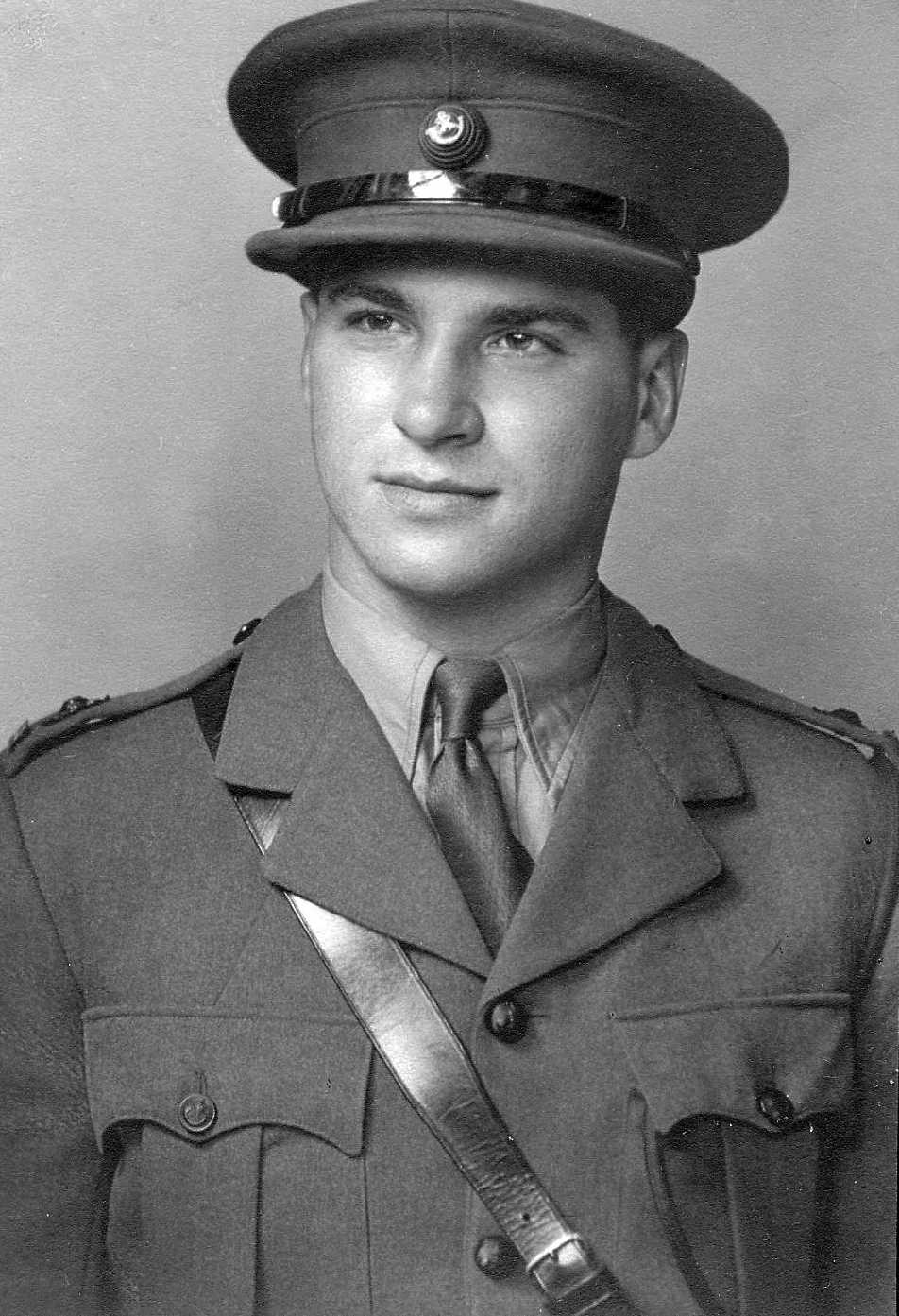
Gerald Infield
kings college cambridge obituary
GERALD MAURICE INFIELD was a wartime army officer and later successful solicitor who established his own practice as the foremost firm in the south London area. As a volunteer at the start of the war, Gerald saw action in North Africa with the Rifle Corps before training as a paratrooper and holding out against the Germans at Arnhem. A natural leader of men, with a reckless streak balanced by a cool head under pressure, he later made an effective and ambitious administrator as head of the eponymous Infields.
Born on 1 June 1921 to a Jewish family in Hampstead, London, Gerald was the focus of pressure and attention from a young age. As toddlers he and his twin sister Elaine - the 'Twinfields' - were much cooed over by visiting friends, although Gerald was unappreciative and used to say firmly: 'No ladies look at Gerald'. Sent to a fashionable private school at Peterborough Lodge, he dominated in sports and did well in class, and was a firm favourite when later made head boy. However, his success only increased the expectations on him to continue to achieve, and whilst being prepared for a scholarship to a top public school, the weight caused him to have a breakdown.
Fortunately, his parents were very understanding, giving up their ideas of a Winchester scholarship and instead sending him to Bryanston, then a new public school with a more liberal regime, alongside contemporaries including Lucien Freud and Freddie Sanger. Here, Gerald once more flourished, captaining the school athletics team and playing for both the 1st XV in rugby and the 1st XI in cricket. A wickedly fast bowler, he once took a hat trick of two county cricketers and a Cambridge blue.
Gerald came to King's in October 1939 to study History, but stayed only for two terms before volunteering for the army. Commissioned into the King's Royal Rifle Corps in 1941, he was sent out to North Africa via the Cape. Driving through the Libyan desert in their small trucks called portees, each equipped with a small gun, Gerald and the other men arrived in time to take part in the battle of Knightsbridge. Yet with a sandstorm at full force screaming around the trucks, firing meant shooting into space, with no idea as to whether the bullets would hit enemies or friends. In the maze of dunes and wind, the soldiers often found themselves wandering in strange and surreal terrain, where manoeuvres could take on a bizarre, dreamlike quality - once, while on exercises, Gerald's troop suddenly found that they were part of a German column, and yet managed to slide away without being noticed.
As the war rumbled on, they fought Rommel at El Alamein, and Gerald's portee was the first British unit to cross the Halfaya Pass. It was in these mountains, though, that he received his first injury. Watching the fighting at Kasserine Pass with some American army officers, to whom he had been attached as a liaison officer, Gerald was hit by a bullet that went through his right arm and punched a hole out of his back. With uncanny sangfroid, however, he got up and managed to walk down the hill to the stretcher bearers, and was still making cheerful conversation while on his way to the hospital. He made a good recovery after several months in a US military hospital in Algeria, spending time swimming in the Mediterranean and swindling Scotch whisky from the British supply store.
Once released, he volunteered for the airborne forces, and was sent back to England to complete parachute training. With the 3rd Parachute Battalion, he took part in the attempt to capture the Rhine Crossings at Arnhem during Operation Market Garden. Now a lieutenant, he and his platoon defended a crossroads north-west of the bridge for several days of intense fighting, holding out against waves of attacks until the struggle narrowed from house to house to room to room, and finally to the exhaustion of their ammunition. Taken prisoner of war, Gerald was held at Oflag 79 near Braunschweig for nine months until liberated by the British Army and sent home on leave. He weighed less than eight stone, and would get up in the night to go to the kitchen and eat bread, which to him had become like cake.
Gerald served as a Staff Captain in the War Office until demobilised in 1946. He had refused to join his regiment out in Palestine, and instead dealt with applications for early demobilisation - all of which he approved! Soon, more than six years after the start of the war, he finally had the opportunity to return to university - and, as still technically in the army, managed to co-opt a truck, complete with soldiers, to act as removals men to his dorm room.
During his time at King's Gerald returned to his love of sports, boxing, playing cricket and rugby, surrounded by lots of other ex-servicemen. He received his BA in 1948 and his MA in 1950, graduating with Second Class Honours in History.
This completed, though, it was difficult to decide what to with his life, especially after six years at war. Gerald was ultimately a practical-minded person, though, and dismissed wistful dreams of wandering round the countryside reciting poetry to become an articled clerk in London. By 1953, hard-working as ever, he had qualified as a solicitor in Hertford. At the same time, he married Ghislaine Freedman and the couple moved to the nearby village of Bengeo, where their son James was born in 1955. The family soon grew, with Catherine born in 1956, Steven in 1958, Anne in 1960, and Andrew in 1961. Meanwhile, Gerald continued to move from success to success at work, though not without some bumps in the road. In the 1960s, he fell out with the other partners at the firm of Templar, Thompson and Passmore in Tunbridge Wells and was forced to leave. In 1968, however, he moved on to join Harold Bell in Esher, becoming an equal partner two years later and opening a branch office in Hampton Wick.
When a difference of managerial styles (and perhaps a clash of personalities) meant that Gerald and Harold decided to split the practice, the branch office became Infields and went from strength to strength, overtaking Harold's branch within the year. An astute businessman, Gerald took pride in building up his practice, and taking on new partners. In a short time Infields became the leading firm the area, and continued to be so well after Gerald's retirement in 1983.
The quietly retired solicitor of Gerald's later years might seem a long way from the brave young officer who drove a truck in the desert and parachuted over the banks of the Rhine, but the same spirit animated them both, and the war had made an indelible mark. Although he had always refused to go to the annual reunions organised in Arnhem by the city council, in 2014 Gerald was persuaded to attend in honour of the seventieth anniversary of the battle. Aged ninety-three, he was surprised and very moved by the reception he was given, and was interviewed by the press, recounting feelings and experiences forged a lifetime ago.
Gerald died on 7 September 2015, aged ninety-five.