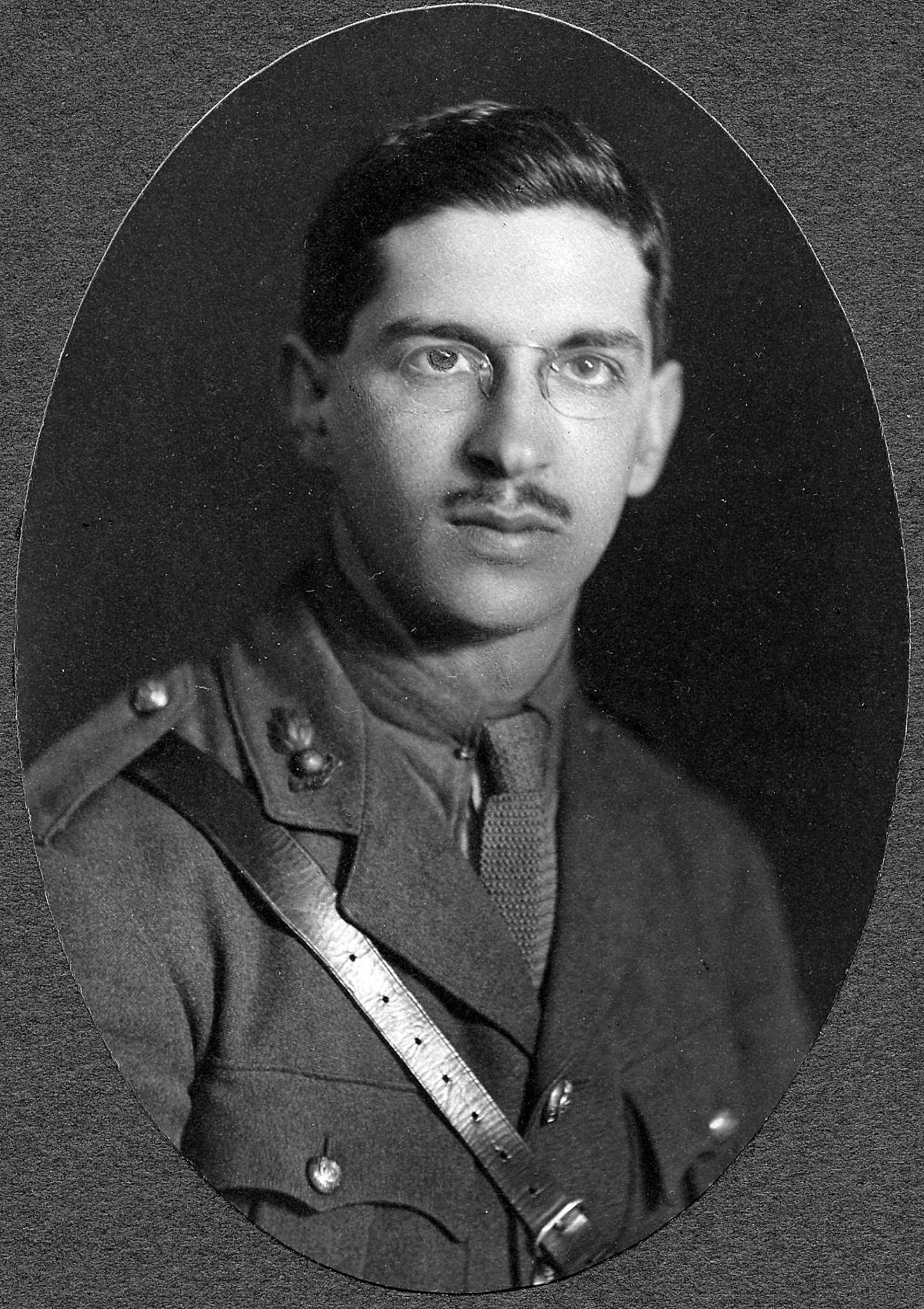
Harry Infield
Kings College Cambridge Obituary
HARRY INFIELD was born at Cracow in 1893 into a Jewish family. His father, a business- man with strong musical and intellectual interests, moved to England at the beginning of this century when Harry was about ten years old, and established a fur business in North London. Harry quickly adapted himself to life in this country and after a successful career at Owen's School in Islington, where he specialised in science, entered King's as an Exhibitioner in 1912. His brother Louis had already pioneered the family's connection with Cambridge as a fine mathematical scholar at Queens', and his cousin Leopold (who collaborated with Einstein at Princeton) was later to be a Rockefeller Scholar at Trinity. Harry showed the same intellectual ability and stamina. In his first year he won first class honours in Physics, his preferred subject; in his second year he read Chemistry, a subject for which he felt rather less sympathy but one he thought would be of use should he enter his father's business. He still reached a high second class.
Then came the First World War. Harry volunteered at once and joined the 12th (London) Regiment of the King's Royal Rifle Corps. In February 1915 he was very badly wounded, shot through the lungs; he had to spend six months in hospital. As soon as he was sufficiently recovered he joined the newly formed Special Brigade for Gas Warfare, and it was with this unit that he spent the rest of the war at the front. His abilities and his courage enforced recognition; he finished the war with the acting rank of Lieutenant-Colonel, and he retired from active service as a Major-and holder of the Military Cross. When the fighting was over his special knowledge was still to be of use to the country. He was seconded to the Foreign Office and served as a member of the Inter-Allied Commission in Upper Silesia.
In August 1920 Harry Infield married Ethel Phillips, whom he had known for many years in London and who was to be his staunch companion for the rest of his life. They had three children, the twins Gerald and Elaine, and Brian, Gerald (1940) and Brian (1943) both came to King's.
On returning to civilian life Harry tried several things but finally decided to read for the bar. With his usual energy and intellectual grasp he studied law in his spare time-he was working in his father's business during the day and passed his examinations with flying colours. He was called to the Bar in 1926 and practised from then until 1941, with success even though he had made so late a start. Had not the Second World War supervened he would probably soon have taken silk.
Harry had stayed in the Territorial Army after the First World War as a very active officer, and it was as an officer of the Territorial Army Reserve that he was recalled in 1941. He served in the Pioneer Corps until 1946. The strains and the family worries of war time, compounded by a sense that he was not being used to full capacity, made this a much less happy time for him, and soon after the war he had to face other troubles. The old lung wound gave concern and a major operation had to be faced. Not fit enough now for the strenuous life at the Bar which he still craved, he occupied himself with various business interests, but, as the years passed, moved towards semi-retirement. He took a house in, Jersey, travelled to South Africa, Israel and Majorca with his wife, took pleasure in his children and grandchildren. In 1963 he suffered a mild stroke, in 1966 a more severe one which lowered him further. He died in Majorca on the 24th February 1968.
……………………..
Harry Infield was a man who strove to excel and who had the character and talents to achieve success. He went a long way and achieved much, but it could have been more and he knew it. Two wars broke his career at vital points and left him physically weakened. But despite this and the tragic death of his daughter he always kept his courage, never showed bitterness or voiced complaint. And though he drove himself he felt consideration for others. Some of the warmest tributes to his character come from those who tell of the comradely warmth joined to officerly concern he showed in the army. These qualities he carried into civilian life with a lively and hardworking interest in the Jewish and other ex-servicemen's associations.